
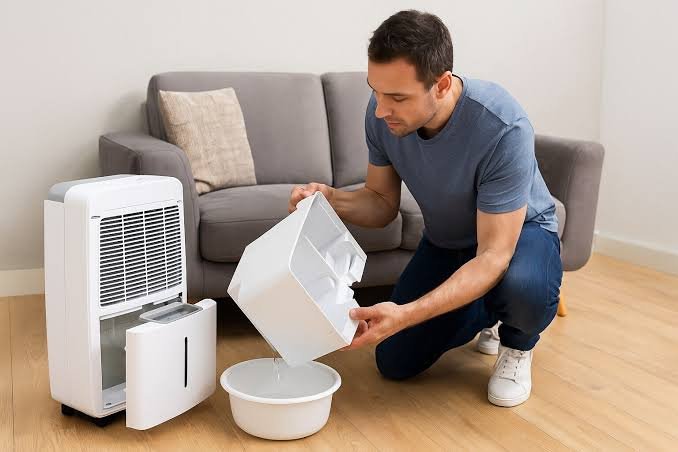
If a household keeps considering another short dehumidifier rental for the same recurring concern, review the pattern before treating the next booking as routine. Temporary equipment can have an appropriate role, but repeated hire does not by itself explain the source or establish a lasting response. Bring the history to a qualified adviser and give the next decision an explicit purpose.
Look at the pattern across bookings
Collect the basic facts from earlier episodes. Identify the room, the concern that prompted each enquiry, the equipment period and any assessment or repair associated with it. The pattern may be clearer on paper than in memory. Keep dates approximate where necessary and distinguish a confirmed recurrence from a general impression that the room has “always been damp.”
Record what actually changed between episodes. A repair, a different use of the room or a professional recommendation may be relevant. Keep available documentation of those changes with the chronology. Do not assume that the same visible symptom means the same cause every time. Equally, do not assume separate bookings represent unrelated events simply because several months passed between them. The purpose of the chronology is to help the responsible adviser ask better questions.
Keep the outcome of each period within what was established. The equipment may have been collected, the household may have noticed a change or a professional may have made a finding. Those are different kinds of information. A return receipt should not be rewritten as proof that the underlying issue was resolved if no such assessment exists in the record.
If there are current hazards, active water or suspected contamination, use the appropriate immediate professional response. A review of historical bookings should not delay help. The longer-term purchasing question can be addressed alongside or after the necessary response, with the present condition assessed on its own facts rather than treated as merely another familiar inconvenience.
Separate immediate control from the underlying response
Health Canada’s moisture guidance emphasizes addressing sources. That principle helps organize the conversation: what role has temporary equipment played, and what has been established about the reason the concern returns? The answers may involve different professionals or work stages, but they should remain connected in the household’s understanding.
Ask the qualified adviser to explain whether the history suggests a question that needs further investigation. The owner should not diagnose ventilation, plumbing or building-envelope conditions from rental frequency alone. A clear request for assessment is more useful than arriving with a fixed theory and asking only which machine will make it easier to live with.
A temporary measure may still be appropriate while another issue is addressed. If so, ask for its purpose and the conditions for review to be stated. That keeps the rental from becoming an indefinite habit with no owner for the underlying question. The household can understand an interim plan without mistaking it for a permanent solution or demanding a certainty the assessment has not yet established.
Avoid assuming the only alternative to repeated rental is buying a larger machine. Ownership changes the commercial arrangement, but it does not automatically answer the building question. A purchase recommendation should follow an understood need and appropriate advice. The decision may involve equipment, a repair, further assessment or a combination; a catalogue alone cannot determine that for the property.
Bring the history to a fresh equipment discussion
When rental fits the current assessed need, Drying Equipment’s Newmarket rental page offers a local starting point. Explain that the enquiry follows earlier episodes and describe the current professional recommendation. Confirm the actual unit, instructions and service arrangements. Do not assume the model or booking terms are unchanged because the household has used the provider before.
The equipment provider should receive the information relevant to its role, while the person assessing the property receives the broader history. If the two need to coordinate, make the connection clear. The homeowner should not have to translate a professional recommendation into a guessed specification or rely on a supplier to infer the building’s cause from an account of previous invoices.
Assign responsibility for operation and review during the new period. Keep the instructions accessible and establish how changes or problems will be reported. Electrical supply, drainage and placement must follow the actual documentation and competent site advice; familiarity with a previous hire is not a reason to improvise a new arrangement. Repeated experience should improve the handover record rather than reduce attention to it.
Choose the next step with an explicit purpose
At the review point, ask what has been learned and what decision follows. If further rental is recommended, understand why and how its need will be reconsidered. If a repair or another assessment is required, identify the responsible person and the next information expected. A useful plan makes the outstanding question visible instead of leaving the household to repeat the same purchase whenever concern returns.
Keep cost discussions tied to actual quoted terms and the assessed work. Avoid assuming reimbursement, a universal savings calculation or a guaranteed duration. The owner can compare the commercial options once the purpose is clear. A seemingly inexpensive repeat hire may still be an incomplete response if nobody has addressed the reason it keeps being needed.
The next booking should be understandable in the context of the property’s history. It may be a justified temporary step, but it should have a role within an informed response and a route for review. Bring the recurring pattern into the conversation, so another dehumidifier period follows a decision about the actual concern rather than simply repeating an arrangement whose purpose has become unclear.




Leave a Reply